Thursday, 26 June 2014

Revolution in Africa - Rwandan (Hutu) Revolution

As I had predicted, about a post or two ago, there have been quite a few revolutions within Africa, very much as a result of the impact of colonialism and imperialism. I am quite glad now actually as the intial research I did regarding imperialism has become somewhat relevant to my investigation. Imperialism is big, there isn't usually a modern history topic that you can't link it to.

After some research regarding the many African revolutions that took place, including the Algerian revolution, the three Egyptian revolutions and Somali revolutions (which seem to be the most prominent), I've come to the conclusion that it will be best for me to investigate the Rwandan revolution (or the Hutu revolution) as it is pretty much the prelude to the Rwandan genocide which is fairly well known, and fairly well written about. I've already found plenty of books on it and hopefully some more when I visit the state library on friday. I've checked through a few books and whilst they tend to focus on the genocide, there are still great portions of information, providing the context behind this 'crime against humanity', which of course is, the Rwandan revolution.
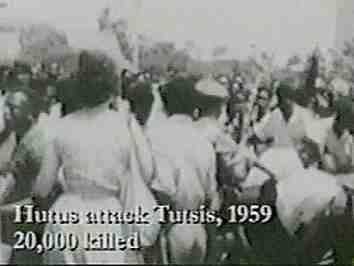
I found this revolution particularly interesting as alluded to above, the political system and the society that came from this 'revolution' resulted in genocide and civil war a few years later. Not only this but it is argued that this particular revolution didn't really enforce much change. Mahmood Mamdani in his book When Victims Become Killers: Colonialism, Nativism, and the Genocide in Rwanda states that "While the Hutu revolution of 1959-1962 had managed to transform the state, its impact on society had been superficial". I felt this quote was extremely important here as its basically saying that formally, there was a change in leaders and a change in the ethnic group that ran the country, there was little transformation in the social change that had occurred in the sense that there was still an 'inferior' race being exploited. Whilst it was indeed the case that there was a shift in power and a different race of people obtained this power, society was not that much different, and so does this then constitute a 'revolution'. A chronology of Rwanda's history is pasted below:

The revolution in Rwanda was not the usual revolution either. Rwanda prior to 1959 was under control by the Belgians (yeah they had part of Rwanda too, they were also notably good at exploiting and being nasty to the natives, then again a lot of Europeans tended to do that...), however there was a system of monarchy where Belgians had the ultimate power, but those who officially exercised the power were the Rwandans. However, the bigger issue is that there were two 'races' of people in Rwanda, the Tutsi's and the Hutu's. The Belgians handed power to the Tutsi's and basically hailed them as the superior race because of their skin colour, and allowed for even graver exploitation of the Hutu's, making them slaves etc. But, you know, being Europeans, the Belgians thought they'd make things worse by formally segregating the two races, setting up the foundation of the 'Rwandan Genocide. This occurred in 1935 when the Belgians handed out identity cards labelling each individual 'Tutsi', 'Hutu', 'Twa' or 'Naturalised'. This formal segregation caused a lot of issues and could be considered a factor influencing this particular revolution.

A postage stamp featuring Grégoire
Kayibanda - celebration of Rwanda's
independence and republic
The revolution occurred essentially when the Hutu got really annoyed with being at 'the bottom', so decided they'd upturn the entire thing by throwing a revolution, removing Beligian control and wreaking revenge on the Tutsi, or at least some kind of 'revenge'. After much struggle, the Hutu gained control of Rwanda, a number of points however should be made from this.

  • The most prominent figure of this revolution was GrĂ©goire Kayibanda who was the first elected president of Rwanda - He replaced the Tutsi monarchy with a republican form of government, and asserted Hutu power (another pro Hutu figure to look into may be Joseph Gitera)
  • The Tutsi monarchy were expecting to gain full control after being given independence from the Belgians, seeing that the Hutu were growing in force and numbers, they too were pushing for independence - this is a rather interesting point as both powers were pushing for independence, however what seemed to distinguish the two was that the Hutu were fighting for a republic, and the Tutsi were fighting for a monarchy 
  • In 1957 the Bahutu manifesto was completed, a document written by Hutu scholars which formally label the Hutu and the Tutsi as two separate races, it also encouraged the transfer of Tutsi power to the Hutu - here we have a formal text, a piece of writing that played an active role in this revolution. 
Whilst I am unsure i'll be able to find many historians commenting collectively on this revolution in comparison with other more prominent revolutions such as the French or American revolution, it does offer an example, where there was an interesting shift of power in the sense that not only was it an overthrow of monarchy, but also a bid for independence from the Belgians. I hope to do further research, more so into the factors of this revolution, but am glad that I have made a decision regarding which revolution to choose. 

Tuesday, 24 June 2014

I am silly...

Ohkay, so I wasn't so smart and I had a cup of coffee to make sure I could finish all my work this evening and now I've found that I can't even really go to sleep. And then I started thinking about history and stuff and was like 'oh I might as well post what I'm thinking, because this is good stuff'. So I just downloaded the blogger app (which is actually quite good for shortish posts like these, but it doesn't have spell check so let's hope my brain isn't to Englished out). I will now proceed to relay my plans for the holidays and the remainder of the week.

I've decided that before jumping into historians and their POV on a number of revolutions I shall investigate and get my head around the revolutions I intend on investigating the historiography of. So! As part of my fun holiday winter plan, I shall be snuggled up in blankets watching movies and reading books on these revolutions. Each revolution will have a day allocated to them, or at least a good chunk of that day (I need to get through game of thrones as well). After I know a decent amount about each of these revolutions, I will then look into the historians perspectives on these revolutions as hopefully then I'll know what they're on about. 

As my revolutions, I've chosen the first Chinese revolution, the American revolution, the French Revolution, and I'm  thinking about one of the Egyptian revolutions, I will just have to make sure I have enough sources available. I like the idea of Egyptian history because you learn about ancient Egypt and then don't really hear much about it again; apart from some of the past news (apparently there is still conflict over there, but obviously, that will not be the revolution I am looking at). 

Whilst unfortunately my drama task has taken up a good portion of working time this week, this upcoming Friday, I will be traveling to the state library to aquire sources (my goodness autocorrect just changed that to spices... No autocorrect, I ain't doing some medieval spice trading, I'm german, I trade sausages... Well... More kind of steal them aggressively but anyway - I mean no harm, I am making fun of my culture - - I am also kidding, I don't steal sausages, my family actually don't really eat many, actually yes they do...). Wow that was a big lot of brackets. 

I've just noticed that my post doesn't have much historical content. So I will announce this random history fact: 
Did you know that during ww1 British tanks were categorised into 'males' and 'females'? The male tanks had cannons and the female tanks had heavy machine guns. 
What an interesting fact. I don't even know if it's true, but then again;
"There is no truth in history, only perspective" 

Overall, I am here to say that I know what I am doing! I am excited for it and I can't wait to post some actual content that I can present.

VIVE LA REVOLUTION! 
POUR JE SUIS LA REVOLUTION! 

Wednesday, 18 June 2014

Ideas! Ideas! Ideas!

After speaking with Mr Bradbury this lesson i've been able to work out a specific direction I can take regarding my revolution topic, which is good because broad research without a purpose can make me rather frustrated. After previously looking at Crane Brinton I had the idea that I could look at the theories behind revolution rather than just a number of revolutions that I will be comparing. Obviously, I will still be comparing revolutions, but comparing them in terms of what they are and the factors that have contributed to either their success or failure. As mentioned in my previous post, I think it will also be interesting to look at what distinguishes a rebellion from a revolution, I think that could even become, somewhat, what my question will ultimately be. So far I have found a number of historians and revolutions I could potentially use.

Historians

These are the five I am going to begin with, in terms of my research. They'll probably begin to change once I get into it, but they're a good bunch to start with. Zagorin (as mentioned above), also names a few scholars who have considered theories regarding revolution including Plato and Aristotle. So far my historians are just handpicked, not randomly, but the first couple I could find. It would be brilliant to have a historian from each particular era to perhaps demonstrate how the ideas regarding revolution and the distinguishing features of a 'revolution' (which separate it from a rebellion or a revolt), have changed over time. 


Of course, i'll also investigate these ideas through looking at four major revolutions and attempting to link these ideas with literal revolutions that have taken place. Here i'll investigate the factors for revolution and then see how they measure up to the ideas that the historians have documented.
My revolutions will be the following:

The America's - The American Revolution

So far i've found a good source regarding this topic, and it is the 'following'. I must admit, I don't know that much regarding the American revolution (most of my information has come from a little game I like to call 'assassins creed'). Pretty much all I know is that Britain was being a stinky poo bum and wanting to have all the land in the world, so when America decided it didn't want any more of Britain's bull****, it wanted to declare independence. But then Britain, being all greedy as it was decided to have a war over some land that wasn't even theirs in the first place (It wasn't entirely the colonists either, but that's another story...). THEN, the colonists decided to be all smart and they threw a bunch of Britain's tea in the water. 
That's all I got. So it will obviously be a good idea to research this topic, since it is very much a 'major revolution', and an important one too. 

Asia - The Chinese Revolution

I'm going to come out here and say I know pretty much nothing. All I know is that it was an overthrow of the Emperor (or the man that was in charge) and then the implementation of some communist party that isn't really that much communist (what are you doing to me china!?). But I think I will enjoy learning some asian history as I really don't know that much at all. It will be good for me. 

Europe - The French Revolution (probably)

The French revolution is cool and I also know some good background on it. It was quite similar to the Russian revolution in the sense that there was a monarchy that was rather oblivious to the struggles that were being endured by the peasants and the lower class peoples (or the third estate), and as a result, well, in simple terms they got cranky and decided they'd had enough and overthrew the monarchy (and chopped off their heads). OH I REMEMBER A GOOD MEME ABOUT THAT! I put it to the side. Look. I like it, its like a crossover between batman and the French revolution, anything that does that is pretty cool. Funnily enough, whilst there's supposed to be humour behind the meme, it's an interesting thought regarding the French having a revolution and then 'losing their heads', or having a revolution and erupting into chaos, before setting down again into an order that wasn't overly different from the previous one. And it poses the question; what was it all for? If a revolution is supposed to be a 'change' in the established order, or if it is supposed to be beneficial in a sense, then how is the French revolution considered to be one? This will be quite interesting to research. 

Africa - (not entirely sure)

Africa have had a lot of wars and rebellions. Of that I am sure. Somewhere they must have had revolutions. I mean, as it can even be seen in my previous research on imperialism, all these countries were once dominated by European powers, and now pretty much all of them are free. It will be interesting to see if there was ever any 'revolutions' or struggles to gain this independence. Either way, however, it will be interesting. 


Overall, I think this is a pretty good start to my research and what will be my question eventually. I am extremely excited to get into the research for these topics! VIVA LA REVOLUTION! 

Tuesday, 17 June 2014

Crane Brinton's Theory of Revolution

Historian Clarence Crane Brinton

It's been a while since my last post. I blame that on the fact that i've been extremely busy with assessment tasks and our latest history debate (that we won yesterday afternoon, WOO!), however I must admit I am glad to be back on track with my research. After I had decided to look at revolutions in general I thought it would be interesting to investigate Crane Brinton's theory of revolution, outlined and explored in his novel 'The Anatomy of Revolution' (I would like to possibly purchase this book). After initial research it seems that Brinton attempts to explain a revolution like a fever, in which the society would initially show symptoms, endure the fever (or revolution), and then reach some state of 'okness' (yes I just created a word). I call this state of 'okness' because Cowie states that a revolution can be a '180 degree revolution' - meaning that there is a complete reversal in both social and political ideals, or a '360 degree revolution' - meaning that the revolution has very much resulted in a society significantly similar to the one prior to the revolution. The fact that a 'revolution' can take on completely different results is quite interesting in itself. Brinton's theory explores a number of factors for revolution and the factors that are a result of a revolution. They are as follows:

Crane Brinton's Fever Chart of Revolution

Factors for Revolution

1. People from all social classes are discontented.
2. People feel restless and held down by unacceptable restrictions in society, religion, the economy or
the government.
3. People are hopeful about the future, but they are being forced to accept less than they had hoped
for.
4. People are beginning to think of themselves as belonging to a social class, and there is a growing
bitterness between social classes.
5. The social classes closest to one another are the most hostile.
6. The scholars and thinkers give up on the way their society operates.
7. The government does not respond to the needs of its society.
8. The leaders of the government and the ruling class begin to doubt themselves. Some join with the
opposition groups.
9. The government is unable to get enough support from any group to save itself.
10. The government cannot organise its finances correctly and is either going bankrupt or trying to tax
heavily and unjustly.


Results of Revolution

1. Impossible demands made of government which, if granted, would mean its end. 
2. Unsuccessful government attempts to suppress revolutionaries.
3. Revolutionaries gain power and seem united.
4. Once in power, revolutionaries begin to quarrel among themselves, and unity begins to dissolve.
5. The moderates gain the leadership but fail to satisfy those who insist on further changes.
6. Power is gained by progressively more radical groups until finally a lunatic fringe gains almost
complete control.
7. A strong man emerges and assumes great power.
8. The extremists try to create a "heaven on earth" by introducing their whole program and by
punishing all their opponents.
9. A period of terror occurs.
10. Moderate groups regain power. The revolution is over.


I think that a good idea for my project would be to investigate Crane Brinton's theory and then attempt to apply it to three or four different revolutions. In order to look at this I would first have to find a way to distinguish revolutions and rebellions. Cowie states that the difference between the two is that a revolution always has a dramatic change in ideology or society at the time (it was a little more specific than that, but I forgot my book... so I will need to do a proper analysis once I am reunited with Cowie). I think it would be interesting to look at a number of revolutions and see how many of these factors can be applied to the revolution, and if the revolution indeed works like a 'fever' as Crane Brinton theorised.


Wednesday, 4 June 2014

It's Time for a Revolution!

Imperialism is difficult to do. I've come to discover such things through my investigation. I think the biggest problem is that the concept is so broad, and can include so many different things that it becomes difficult to condense the investigation to a good focus question that can be answered in the period of 10 minutes (I would love the entire hour of the lesson, but such things cannot be fairly done).

This has led to a complete revolution of ideas!
I have now chosen to explore the concept of a revolution. It was actually what I had previously wanted to do, but felt uneasy doing it as the last two topics were based on case studies regarding revolution (I also thought Mr Bradbury had said it wasn't wise to do it, but now he's decided he said no such thing. I can't remember the truth of the situation to be honest, but anyway, what matters now is that I can do the concept of revolution).

I thought it would be wise to focus my studies around the factors of success within a revolution. This idea was very much inspired from an old history debating topic 'That leadership is the key factor in the success of a revolution'. I obviously (and unfortunately) won't be arguing that either side is the case, but will be reflecting on the multiple factors within a revolution and from there determining how important each of them are in causing a revolution to take place, and then the level of success from this revolution.

There are a number of factors that many historians discuss as being critical or of significance to the revolution taking place. These generally involve positive or negative forms of leadership, social and economic conditions and the need for change.

Over the next two weeks I am to research a number of historians who will have different viewpoints on the factors of revolution and then compare them together using four case studies.
For the case studies, I am thinking two political revolutions and two economic revolutions. Two I definitely want to include are the French and Industrial revolutions. 


Wednesday, 28 May 2014

Europe's Imperialist Powers

I really should be doing my ancient assignment due this friday, but I was once again sidetracked when my research started to mention the spanish influence in Peru (I am researching the Inca civilisation as part of my Ancient history task, in the midst of looking for historians and sources i've come across the whole Spanish influence, since they were the first country who took interest in the place, anyway). I think i'll just have do deal with the fact that the influence of imperialism is almost everywhere, which is why I thought it would be such a great topic to research.

Since becoming sidetracked from history with other not-being-assessed-on-yet history, I researched three other imperialist powers apart from Spain. This included Britain, Germany and France.


The Imperialist Power of Britian

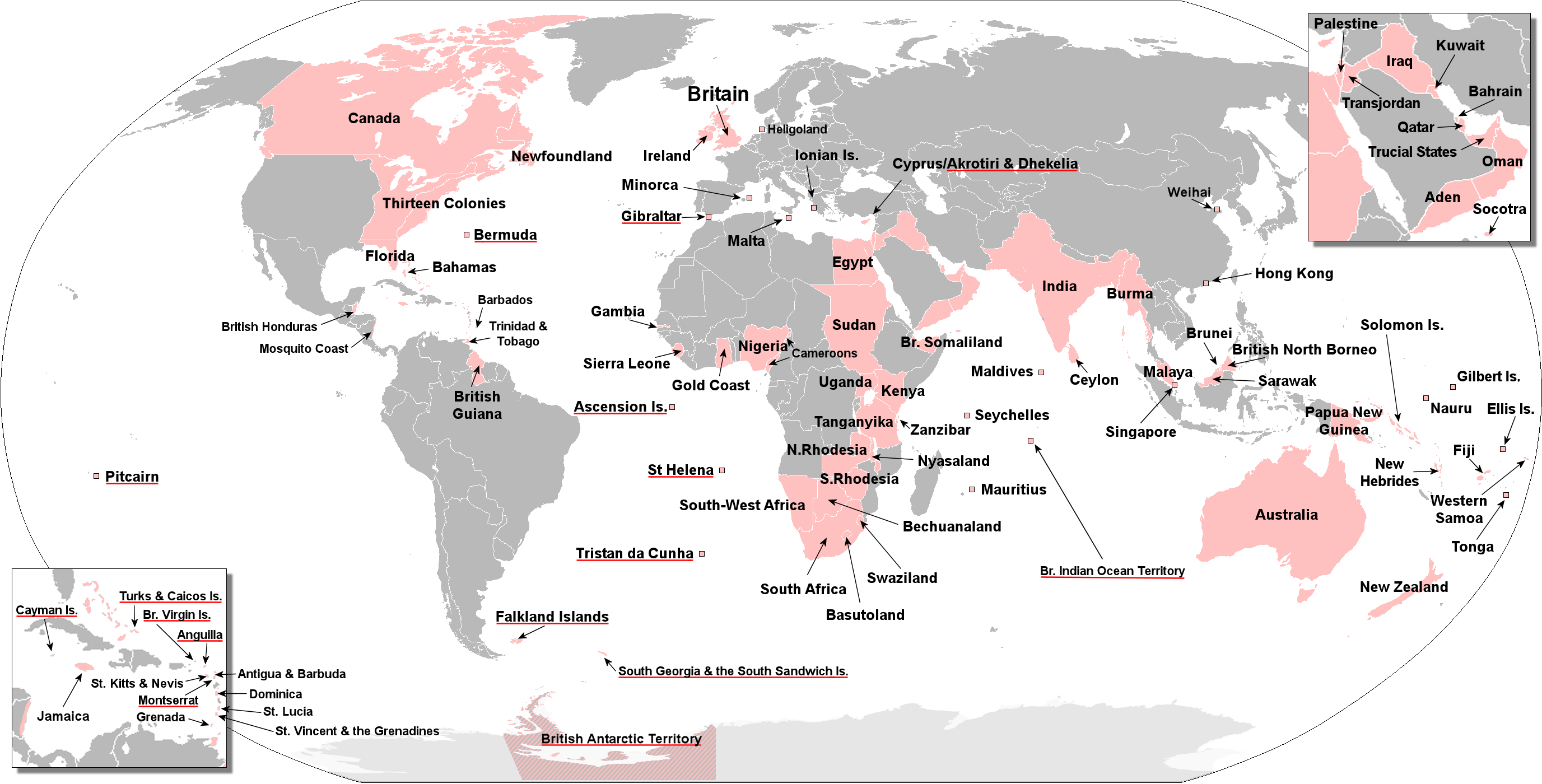
Yes, we're talking about the British Empire. One of the only countries to conquer a big good chunk of every continent. Even Antarctica. Britain would be a fun imperialist power to research, but they've really been known for being everywhere so it would be of significant difficulty to then narrow down my results to a singular, or even a few singular countries. 
This map shows the extent of their empire. 
Looking at this map actually reminded me of a little joke I found a while back. 
I mean look at the little guy, isn't he cute? 
It's obviously a biased perspective, but looking at the map above, one cannot say it is entirely false. 

It truly was an "Empire on which the sun never sets". And I suppose a really good question to ask then, would be, is that a good thing? 
And if it is good, to what extent is it good? 
I think if I do stick with imperialism, that will be the kind of focus question I will move towards, especially since looking at the British Empire now, well... its a lot smaller. So you'd have to question, is that because people realised the so called 'exploitation' of other countries was a terrible thing, or that times had changed to the point where imperialism was no longer needed as the individual countries had reached a point of independence? Oh the things one must ponder. 


The Imperialist Power of France

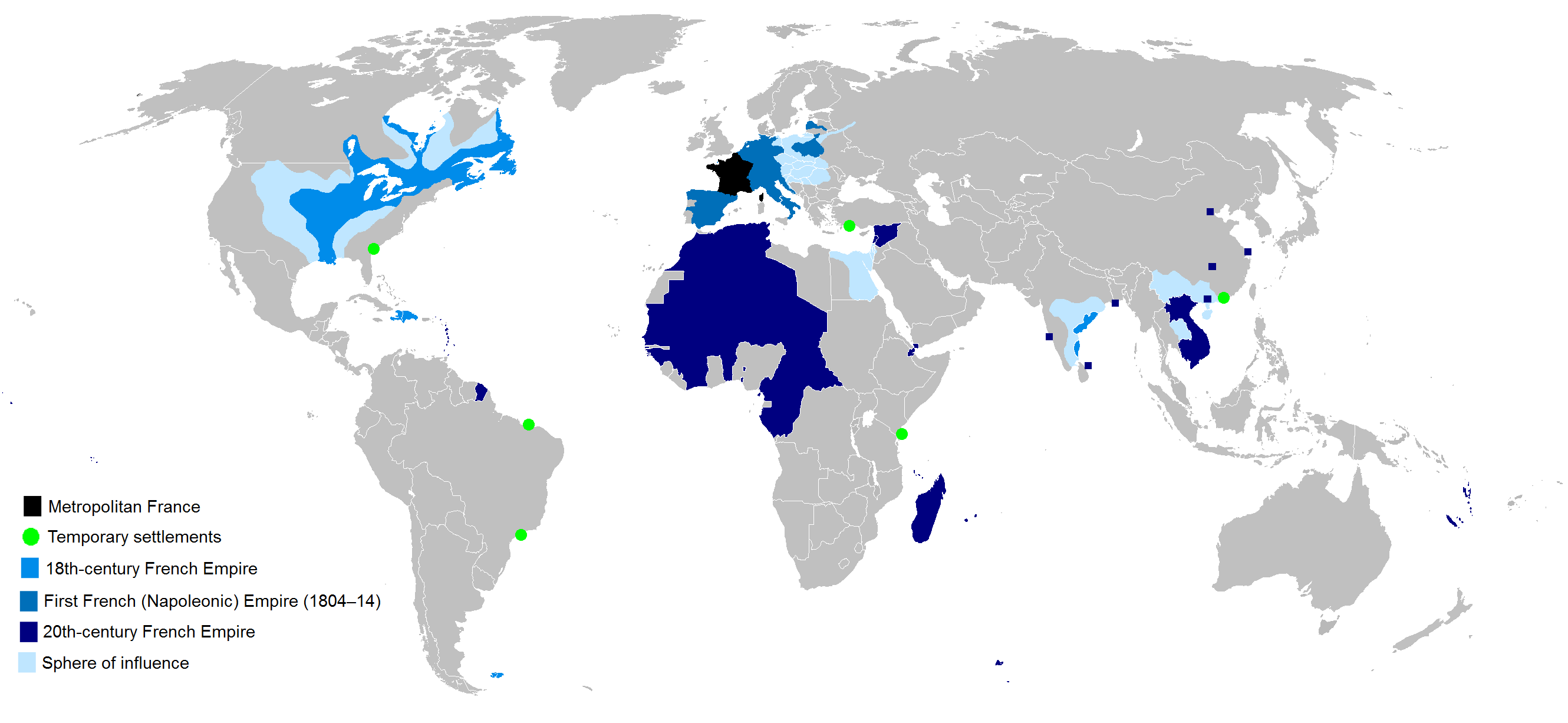
I must admit that looking at France as an imperialist power would be quite interesting since unlike Britain, it wasn't a big growth and then decline, but rather a fluctuation of different territories (France got around, but it liked to focus on a particular area for a while.) I also found this map of France's empire. You can see with the different shades of blue, the fluctuation in territories. 
Now, the good thing with doing France as an imperialist power means that I could focus on the territories it held over a specific time period. For example, I could do the Napoleonic Empire (WOO!), which would actually give me the ability to focus on a concept but also speak about Napoleon Bonaparte. The thing with France is that they always had an interesting looking empire. So yes, i'm definitely thinking about looking at their imperialist influence. 


The Imperialist Power of Germany

I think this Empire says enough for itself. 
Though, in the defence of Germany, they were a bunch of states which weren't completely united until after the Franco-Prussian war which ended in 1870. That also meant that they didn't begin building imperialist power until that time, so they were a little late in their quest for territories (clearly). 
But yet again, whilst researching this topic, Bismark has come up once again. 
If I was to do Germany as an imperialist power, I would definitely focus on Bismark and his policies, however, since they were so late to build up this imperialism, I don't think I would focus on 'the German Empire', rather an entire continent, like Africa, in which they would be included. 


The Imperialist Power of Spain

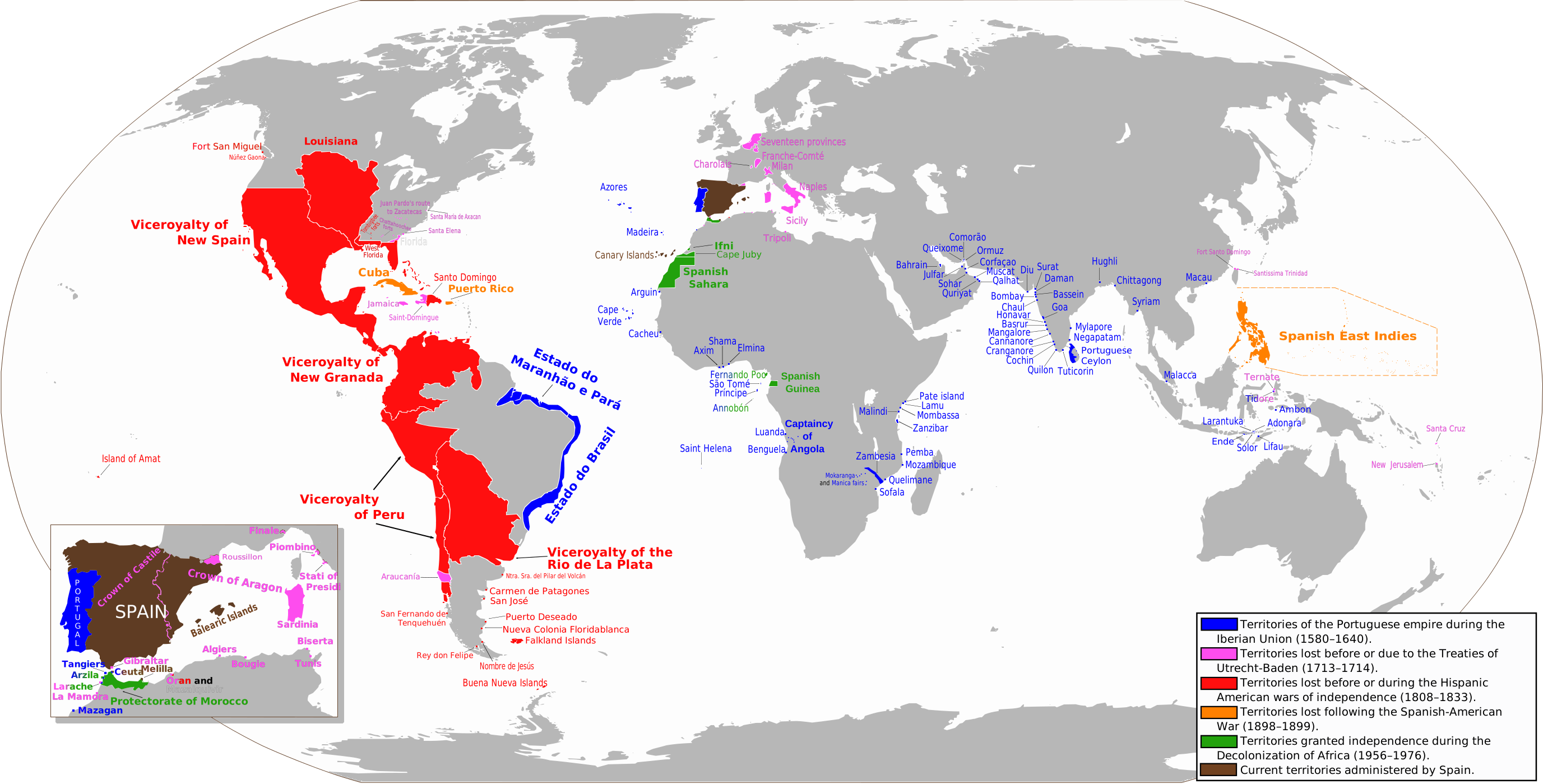
Spain has always fascinated me. They had a huge influence in South and Latin America, and an even bigger influence on the native peoples of those places. Whilst basically all those countries have now declared independence, doing readings on the actual initial conquering of Latin and South America, the Inca's, Aztecs etc were actually quite welcoming to the Spanish (this story goes a while back, but they essentially believed that the Spanish were gods, and treated them accordingly). But any who, their empire looked a bit like this:
As you can see, a very significant influence on the Americas. Doing research on the Spanish influence in the Americas could be an ideal topic as there is an automatic scope placed on it and I am rather interested to learn more about the ways in which the spanish interacted with the native people in the Americas.


Overall, whilst I do understand that I still haven't actually started to focus on a specific area, I feel that putting these ideas down and then contemplating them will help me in finally choosing what I wish to do. At this point, none of the ideas i've suggested to myself really make it for me as a topic of interest, I really hope whilst wallowing in this research, I find a good focus area that I feel passionate about.
Unfortunately, I'm still looking. Fortunately, it's only been three days, and I still have a good long while. 

Tuesday, 27 May 2014

Imperialism in Africa


I've been busy looking at the 'colonisation of Africa' by the european powers, obviously leading to their domination over the countries and continent. After reading an article by Ehiedu E. G. Weriebor it has become clear that there were three main reasons to employ what Weriebor describes as 'imperialist aggression'. These were social, political and economic factors.

Economic Factors

This occurred with things such as the collapse of the profitability of the slave trade. Mostly since it was abolished and suppressed; the Europeans aimed to find another way to gain profits (or exploit and abuse the people of another continent, as the europeans tended to do). 
The colonisation of africa was also influenced by the growing capitalist industrialisation within Europe, which led to the demands of raw materials, and other profitable investment outlets. 
Weriebor concludes that economic factors were probably the strongest which led to imperialism in Africa. 

Political Factors 

Weriebor also comments on the fact that the European countries were struggling constantly for power and preeminence (as the Europeans often did). Essentially, they strived for power within 'European power politics'. And what better way to assert this dominance than to conquer as many countries as you can? 
It was very much like those little competitions kids would have in the school ground. "Look how many scoobies (what a weird name that is) I have..." which would often be responded to by "Well I actually have more", and then that kid would go home and beg their parents for more. It's a very terrible example, but put simply; the more you own, the more power you have. 

Social Factors

As a result of industrialisation, as mentioned above, there were also a few social factors which included; unemployment, poverty, homelessness, social displacement from rural areas etc. Weriebor states that this basically occurred as not everyone could be absorbed by this new capitalist industry, and as a way of solving this issue, countries would often establish colonies, in places like Africa and then export this 'surplus population'. 


This all led to what was known as 'the scramble for Africa'. Because of this 'scramble', there were often also fears that wars and conflict would break out with all of these strong and influential imperialist powers. Otto Von Bismark (who appears to be this insanely awesome guy) held the Berlin conference between November 1884 to February 1885, which led to the implementation of the 'Berlin act' to guide the conduct of imperialist powers. A few of its points included:
- The Principle of Notification (notifying) other powers of a territorial annexation
- The Principle of Effective Occupation to validate annexations
- Freedom of Trade in the Congo Basin
- Freedom of Navigation on the Niger and Congo Rivers
- Freedom of Trade to all nations
- Suppression of the Slave Trade by land and sea

I feel that perhaps doing further research into this 'Berlin Act', could be an area of investigation for my research task, were I to focus on imperialism in Africa. However, I do still wish to do further research into some other areas before deciding where to allocate my focus.